
What Causes Mold Behind Drywall? 7 Hidden Moisture Sources in Charlotte Homes

What causes mold behind drywall in Charlotte homes is sustained moisture inside the wall cavity, most commonly from plumbing leaks, roof or window water intrusion, bathroom moisture, HVAC condensation, appliance leaks, indoor humidity, or building materials that remained damp after an earlier water event.
We provide mold remediation in Charlotte, NC, and one of the most useful lessons from local moisture investigations is that visible wall staining is often only a clue. The real question is how moisture entered the wall, where it traveled, and whether the drywall, insulation, wood framing, or adjacent materials had enough time to dry.
Mold spores naturally exist in indoor and outdoor air. Growth becomes possible when those spores reach a sufficiently damp surface. The Environmental Protection Agency therefore identifies moisture control as the central principle of indoor mold control and specifically lists the back of drywall, wall cavities around pipes, condensation areas, ductwork, and roof materials as common locations for hidden mold.
For Charlotte homeowners, understanding the moisture source matters more than simply identifying a spot on the wall. Once you understand how water reaches drywall, you can make better decisions about inspection, drying, repairs, and prevention.
Why Does Mold Develop Behind Drywall?
Drywall creates an interesting wall assembly because it contains both mineral and organic components. The gypsum core is primarily mineral based, while the paper facing provides an organic surface. Wood studs, dust, insulation components, wallpaper adhesives, and other materials inside the wall can also provide surfaces where mold can develop when moisture remains available.
The EPA notes that mold can grow on materials including paper and wood and that indoor mold growth is fundamentally connected to available moisture.
A typical sequence looks like this.
Water or humid air enters the wall cavity. The paper facing of the drywall, insulation, framing, or nearby materials absorb or collect moisture.
Because air circulation inside a finished wall is limited, those materials may dry more slowly than an exposed surface. When moisture remains available, mold spores already present in the environment have conditions that can support growth.
This explains why a wall can look normal from the room even while moisture is present behind it.
Why Hidden Wall Moisture Deserves Special Attention in Charlotte
Charlotte homes experience a combination of warm seasonal temperatures, rainfall, indoor air conditioning, plumbing systems, roof penetrations, windows, exterior wall assemblies, attics, and crawl spaces. The National Weather Service maintains extensive Charlotte climate records covering both temperature and precipitation, illustrating the regular moisture and temperature changes local buildings experience throughout the year.
Air conditioning adds another building science factor.
During warm weather, indoor wall surfaces can remain considerably cooler than outdoor air. If warm humid air enters an exterior wall cavity and contacts a sufficiently cool surface, the air can reach its dew point and water vapor can condense.
This does not mean that every Charlotte wall develops condensation. A properly functioning building envelope, suitable insulation, effective moisture management, balanced indoor humidity, and correctly operating HVAC equipment all help wall assemblies remain dry.
The important point is that mold behind drywall usually has a moisture pathway. Finding that pathway is more useful than focusing only on the visible wall surface.
1. Slow Plumbing Leaks Inside the Wall
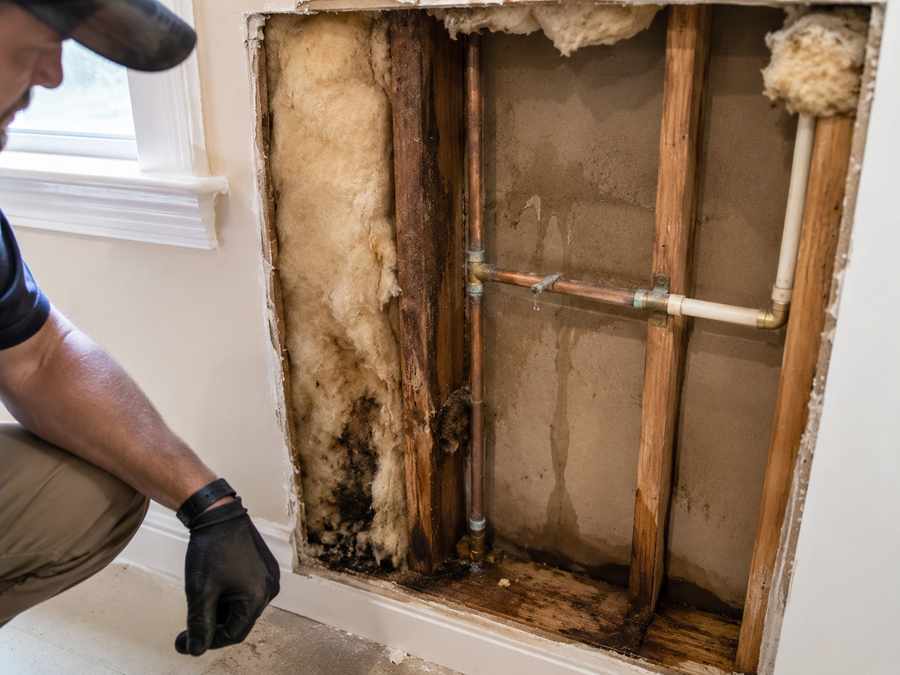
A small plumbing leak is one of the clearest explanations for mold behind drywall.
Water supply lines and drain pipes frequently travel through wall cavities. A fitting, connection, valve, drain assembly, or pipe can release a relatively small amount of water without producing an immediate puddle in the room.
Instead, moisture may contact:
drywall paper
wood studs
wall insulation
bottom plates
subfloor materials
cabinet backs
baseboards
Because these materials sit inside enclosed spaces, the moisture can remain present longer than water on an open floor.
The EPA specifically identifies leaking and condensing pipes inside wall cavities and pipe chases as sources of hidden moisture and mold growth.
Where plumbing related wall moisture often appears
Bathrooms, kitchens, laundry rooms, utility areas, and walls shared with plumbing fixtures deserve particular attention.
For example, moisture behind drywall near a shower does not automatically mean the shower itself is responsible.
The moisture could originate from a supply line, drain connection, valve body, shower assembly, adjacent pipe, or water entering from another level of the home.
Water also follows gravity and building materials.
A stain appearing near the bottom of a wall may originate higher in the assembly.
That is why the location of a visible stain does not always identify the actual source.
2. Roof Leaks That Travel Into Wall Cavities
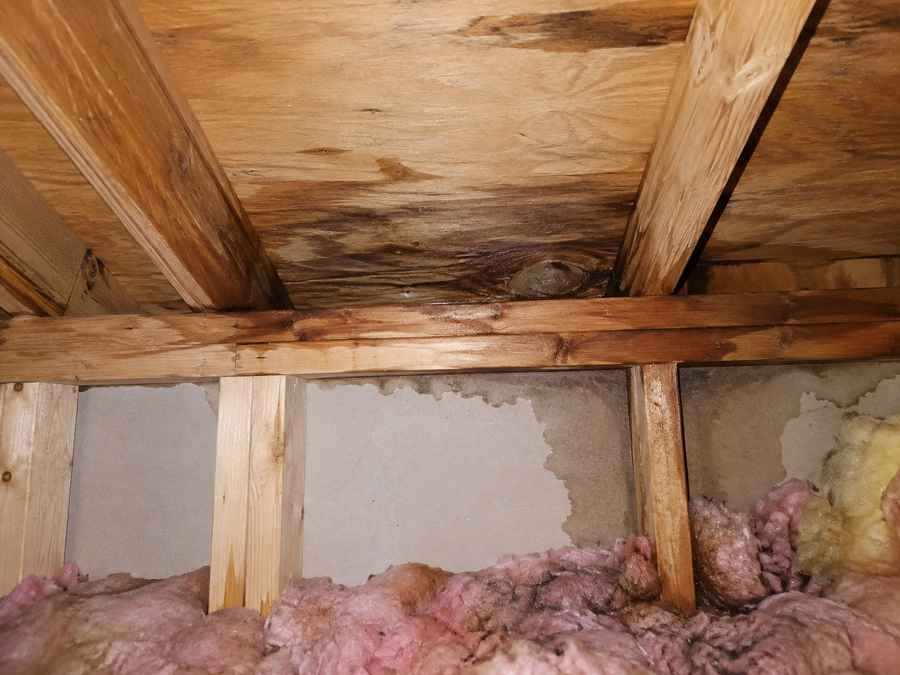
A roof leak does not always produce a ceiling stain directly beneath the entry point.
Water can enter around roofing materials, flashing, roof penetrations, vents, valleys, or transitions and then travel along:
roof decking
rafters
trusses
insulation
wall framing
electrical penetrations
drywall surfaces
Eventually, that moisture can enter an exterior or interior wall cavity.
The EPA lists roof leaks and roof materials above ceilings among recognized sources and locations of hidden moisture and mold.
This creates an important diagnostic lesson for homeowners.
Mold behind a wall can originate above the wall
If discoloration appears near the upper corner of a room, around a ceiling transition, or beneath an attic area, look at the entire moisture pathway rather than only the drywall.
A repaired roof leak can also leave materials damp if the wall or attic assembly was never fully dried.
Stopping water entry and drying the affected assembly are two separate steps.
3. Window and Exterior Wall Water Intrusion
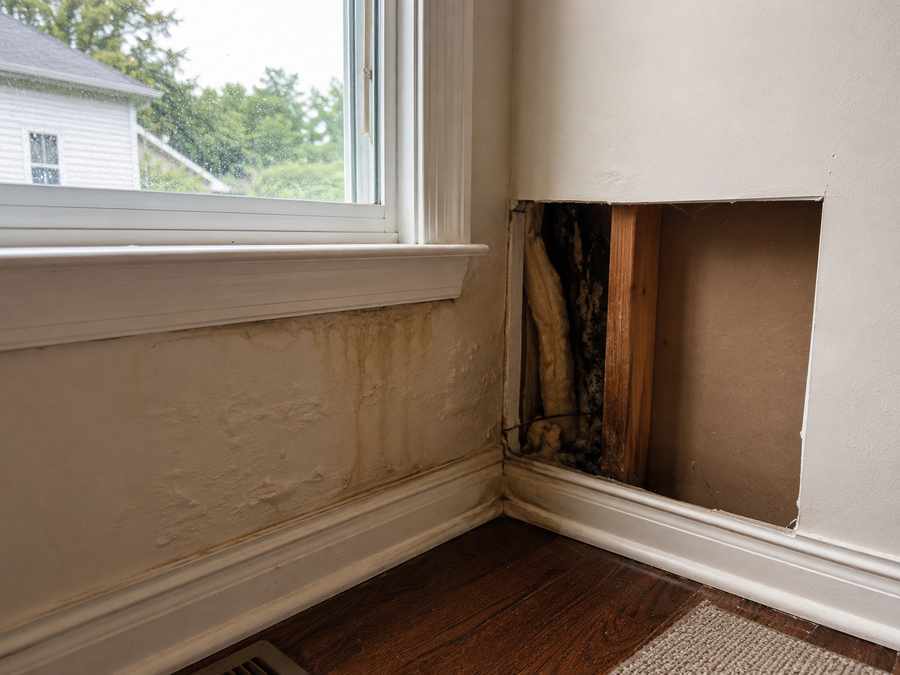
Windows are openings in the exterior building envelope, which means they depend on several components working together to manage rainwater.
These can include:
window flashing
sealants
sill details
drainage paths
exterior cladding
trim
house wrap
wall sheathing
Water entering around a window may travel behind the finished drywall rather than immediately entering the room.
A homeowner may first notice:
a water stain below the window
soft drywall
paint bubbling
swollen trim
discoloration near a corner
a recurring musty odor
The visible symptom may appear several inches or even several feet from the entry point depending on how water travels through the assembly.
Why recurring wall stains matter
If a stain returns after repainting, the wall surface may not be the source of the condition.
The underlying moisture pathway deserves attention.
Painting changes the appearance of the drywall. It does not correct water entering around flashing, framing, plumbing, roofing, or another part of the building envelope.
The EPA similarly advises correcting moisture sources before painting mold affected surfaces.
4. Bathroom Moisture Entering Behind Drywall
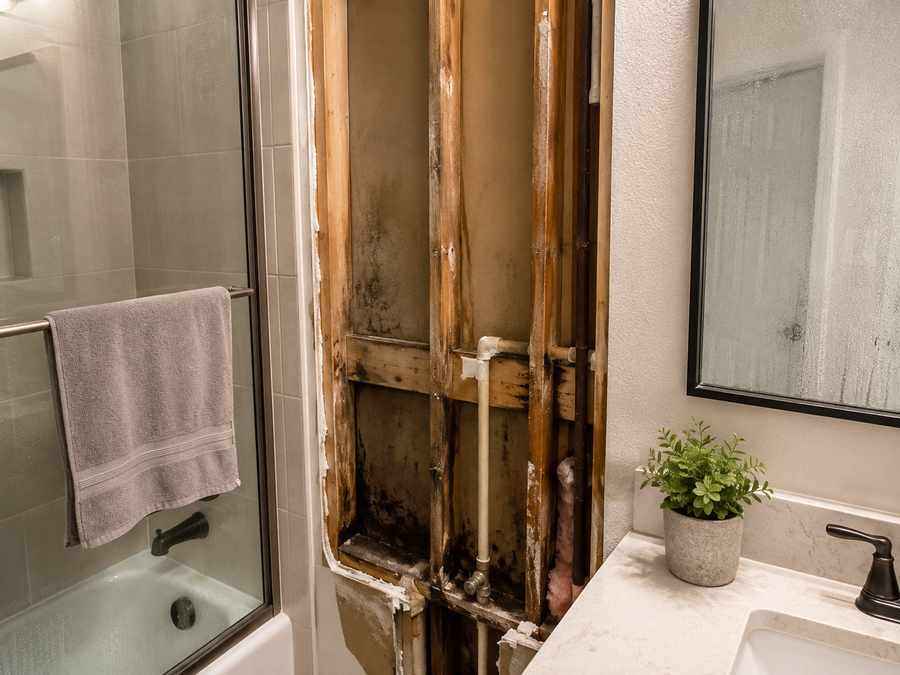
Bathrooms generate considerable water vapor and contain multiple plumbing connections within a relatively small area.
Potential moisture pathways include:
shower plumbing
tub plumbing
supply valves
drain connections
toilet connections
sink plumbing
tile transitions
shower enclosures
wall penetrations
ventilation conditions
A bathroom can therefore experience both liquid water intrusion and elevated humidity.
When warm moist air repeatedly contacts cooler surfaces, condensation can contribute additional moisture. EPA guidance specifically recommends controlling indoor humidity and using bathroom ventilation during showering.
Bathroom mold behind drywall is often a moisture management issue
Consider a bathroom wall shared with a bedroom.
The bathroom surface may appear normal while moisture reaches the back side of the bedroom drywall. The wall cavity can therefore contain a moisture condition that is not obvious from either room.
This is one reason wall cavity conditions should be evaluated according to the building layout, plumbing locations, ventilation, and moisture history rather than appearance alone.
5. HVAC Condensation and High Indoor Humidity
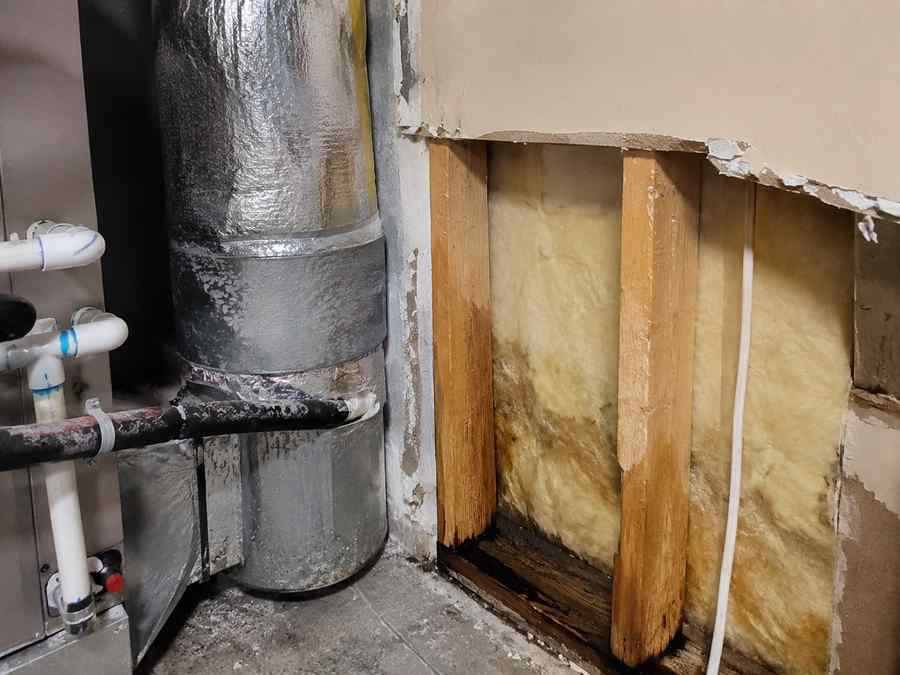
Not every moisture problem behind drywall involves a traditional leak.
Condensation can also supply moisture.
The EPA identifies condensation, high relative humidity, air conditioning components, cold surfaces, and HVAC related moisture as important parts of indoor moisture control. It recommends keeping indoor relative humidity below 60 percent when possible, with an ideal range between 30 and 50 percent.
Several HVAC related situations can contribute to moisture near walls.
Condensate drainage can become restricted.
Cold ducts can collect condensation when surrounded by warm humid air.
Insulation around HVAC components can influence surface temperature.
Air leakage can move humid air into cooler building cavities.
Cooling equipment sizing and operation can affect indoor moisture removal.
Condensation follows temperature and humidity
Warm air can hold more water vapor than cooler air.
When humid air contacts a surface that is below its dew point temperature, some of that water vapor can become liquid water.
Inside a wall, this may occur without any plumbing component releasing water.
That distinction matters because repairing a pipe will not solve a condensation driven moisture condition.
The actual solution depends on why moisture is accumulating.
6. Appliance and Fixture Leaks
Some hidden wall moisture begins with appliances rather than pipes inside the wall itself.
Common sources include:
dishwashers
refrigerator water lines
washing machines
water heaters
ice maker lines
utility sinks
toilets
vanities
A small refrigerator supply line leak, for example, can release water behind cabinetry where it reaches the wall before becoming visible on the kitchen floor.
Similarly, a dishwasher connection can introduce moisture into the cabinet and wall area while the finished drywall remains visually unchanged.
Follow the moisture path rather than the appliance location
Water can travel along flooring, framing, cabinet bases, pipes, and wall plates.
Therefore, an appliance leak in one area can contribute to moisture in another part of the wall assembly.
This is particularly important when the visible stain seems slightly removed from the appliance.
7. Drywall That Never Fully Dried After Earlier Water Damage
One of the most overlooked causes of hidden mold is an earlier water event.
Examples include:
a pipe repair
a toilet overflow
a roof leak
a washing machine release
a storm related water entry
a plumbing fixture leak
water from an upper floor
The visible water may be gone while moisture remains inside insulation, behind baseboards, on the back of drywall, or within wood framing.
This is why surface dryness does not always prove that an entire wall assembly is dry.
The EPA recommends drying wet materials within approximately 24 to 48 hours because timely drying substantially reduces the opportunity for mold growth.
The drying clock applies to materials, not just surfaces
Imagine that water reaches a wall containing drywall, fiberglass insulation, and wood framing.
The painted drywall surface might feel dry first.
The insulation inside the cavity may retain moisture longer.
The wood framing may dry at a different rate.
The paper on the back of the drywall may also remain exposed to moisture.
Effective drying therefore means evaluating the affected assembly rather than simply waiting until the visible surface feels dry.
What Are the Most Common Signs of Mold Behind Drywall?
Hidden mold does not always produce visible growth on the room side of the wall.
Instead, homeowners may notice indirect clues.
A persistent musty or earthy odor without an obvious source can indicate growth in a concealed location. Water staining can suggest a current or previous moisture pathway. Changes in paint, wall texture, drywall firmness, or trim may indicate that the wall has absorbed moisture.
EPA guidance specifically notes that hidden mold may be suspected when a building smells moldy without an obvious visible source or when there has been previous water damage. The agency identifies the back side of drywall and areas inside walls around leaking or condensing pipes as common hidden locations.
Current search results for this topic also repeatedly associate hidden wall mold with musty odors, discoloration, water stains, texture changes, and previous moisture events.
These clues are useful, but none of them alone identifies the exact moisture source.
The goal is to connect the visible clue with the building condition that created it.
Can Mold Grow Behind Drywall Without a Plumbing Leak?
Yes.
A plumbing leak is only one possible source.
Mold behind drywall can develop where moisture comes from condensation, roof water, window intrusion, elevated humidity, HVAC components, or an earlier water event.
The EPA specifically recognizes condensation, leaking roofs, high humidity, condensing pipes, HVAC drainage, and hidden wall moisture as possible contributors.
This distinction is especially valuable when a plumber checks the wall and finds functioning pipes.
The next question should be:
Where else could moisture be entering or condensing inside this assembly?
That question often leads to better answers than assuming every damp wall contains a plumbing leak.
Can Mold Grow on the Back of Drywall While the Front Looks Clean?
Yes.
This is one of the defining characteristics of hidden wall mold.
EPA guidance specifically lists the back side of drywall as a location where concealed mold can grow.
The back side may experience different conditions from the painted room surface.
It can contact:
insulation
wood framing
pipes
humid cavity air
exterior sheathing
condensation
water traveling from above
The painted surface facing the room may therefore remain visually clean during the early stages of a concealed moisture condition.
How Quickly Can Mold Develop Behind Wet Drywall?
There is no single clock that applies to every wall because temperature, airflow, material type, humidity, and the amount of water all influence drying.
However, the EPA recommends drying water affected materials and areas within approximately 24 to 48 hours to help prevent mold growth.
For homeowners, the practical lesson is simple.
Do not wait for visible mold before addressing wet drywall.
If water has entered a wall cavity, focus first on stopping the water source and determining whether the materials inside the assembly are actually drying.
Does a Musty Smell Mean Mold Is Behind the Wall?
A musty smell can be an important clue, especially when there is no visible source.
The EPA specifically states that hidden mold may be suspected when a building smells moldy but the source cannot be seen.
Still, odor alone cannot identify:
the exact location
the size of the affected area
the moisture source
which materials are involved
whether the moisture condition is current or historical
Think of odor as information that justifies investigating the moisture history of the area.
Can Moisture Behind Drywall Be Present Without a Visible Water Stain?
Yes.
Wall cavities can contain moisture before staining becomes visible on the finished side of the drywall.
The water may remain:
on the back paper
inside insulation
along a stud
near a pipe
on sheathing
around a window opening
near the bottom plate
This is why moisture investigations often consider both the visible room surface and the concealed construction behind it.
A clean looking wall does not provide complete information about the wall cavity.
Should You Open the Wall to Look for Mold?
Opening drywall can provide access to the wall cavity, but it should be approached carefully when hidden mold is suspected.
The EPA explains that investigating hidden mold can require caution because disturbing concealed growth can release spores into the surrounding area. The agency recommends considering an experienced professional when hidden mold is suspected.
A more informed sequence is usually:
identify the likely moisture source
evaluate the moisture pattern
determine which materials may be affected
plan access appropriately
control the work area when conditions require it
correct the moisture source
dry or remove affected material as appropriate
restore the wall after moisture control has been confirmed
The order matters.
Opening a wall without understanding where the moisture came from may reveal the condition without solving its cause.
How Can You Tell Whether the Moisture Is Current or From an Old Leak?
This is one of the most useful questions a Charlotte homeowner can ask.
A water stain only proves that water reached the material at some point.
It does not automatically reveal whether the moisture source is active today.
Useful context includes:
when the stain first appeared
whether it changes after rain
whether it changes when a plumbing fixture is used
whether it appears during air conditioning season
whether a pipe was previously repaired nearby
whether the roof has a known water entry history
whether the wall remains elevated in moisture
whether trim or drywall continues changing
Patterns can help narrow the cause.
A stain that expands after rainfall points toward a different moisture pathway than a stain that appears when an upstairs shower is used.
This type of cause focused reasoning is far more useful than assuming that every brown spot has the same explanation.
What Should Charlotte Homeowners Do When They Suspect Mold Behind Drywall?
Start with the moisture source.
If water is currently entering from plumbing, roofing, a window, HVAC equipment, or another building component, addressing that source is the foundation of the solution.
Next, determine which materials became wet and whether they dried adequately.
This distinction is important because the visible face of drywall does not reveal the moisture condition of every material behind it.
The EPA summarizes the principle clearly: moisture control is the key to mold control.
For concealed wall conditions, the objective is therefore broader than simply cleaning a visible spot.
It is to understand:
where moisture originated
how far it traveled
which materials absorbed it
whether moisture remains
whether hidden growth is present
what must happen before reconstruction
Our team is highly experienced in mold remediation Charlotte, NC homeowners need when moisture is concealed inside finished building assemblies, and the most useful starting point is always understanding the relationship between the mold and the water source.
How Can Mold Behind Drywall Be Prevented?
Prevention begins with controlling water and humidity.
Repair plumbing leaks promptly.
Maintain roofing and flashing.
Pay attention to recurring window moisture.
Keep HVAC condensate systems operating correctly.
Use bathroom ventilation.
Manage indoor humidity.
Dry water affected materials promptly.
Investigate recurring stains rather than repeatedly covering them.
The EPA recommends indoor relative humidity below 60 percent when possible and identifies 30 to 50 percent as an ideal range. It also recommends addressing condensation on walls, windows, and pipes and drying wet materials promptly.
The larger principle is even simpler:
A dry wall cavity gives mold far fewer opportunities to establish growth.
Related: Mold Smell But No Visible Mold? Where Hidden Mold Can Grow Inside Charlotte Homes
Frequently Asked Questions About Mold Behind Drywall
What is the main cause of mold behind drywall?
The main cause is moisture that remains available inside the wall cavity. That moisture may come from plumbing, roofing, exterior water intrusion, condensation, HVAC equipment, appliances, or earlier water damage.
What does mold behind drywall usually smell like?
People commonly describe hidden mold odors as musty or earthy. The EPA recognizes an unexplained moldy odor as one possible reason to investigate concealed mold.
Can condensation cause mold inside walls?
Yes. Condensation can occur when humid air reaches a sufficiently cool surface. The EPA identifies condensation and high humidity as recognized moisture sources associated with indoor mold growth.
Can a roof leak cause mold behind drywall?
Yes. Roof water can move through decking, framing, insulation, ceilings, and wall cavities before becoming visible indoors. Roof leaks are specifically listed by the EPA among moisture sources associated with hidden mold.
Can mold grow inside a wall after the leak has already been repaired?
Yes, if materials inside the wall remained damp after the water source was corrected. Repairing the leak stops new water entry, while drying addresses moisture already absorbed by building materials.
Does drywall always need to be removed when mold is behind it?
The appropriate response depends on the extent of growth, the condition of the porous material, the moisture source, and the affected assembly. EPA guidance notes that porous materials can be difficult to clean completely when mold becomes established within them.
How do you prevent mold from returning behind drywall?
Correct the moisture source first, dry the wall assembly, maintain suitable indoor humidity, manage condensation, and complete repairs only after moisture conditions have been addressed.
The Most Important Thing to Remember
Mold behind drywall is rarely just a drywall issue.
It is usually a moisture pathway issue.
A plumbing connection, roof penetration, window opening, bathroom, HVAC component, appliance, humidity condition, or earlier water event introduces moisture. That moisture reaches materials inside the wall. Limited airflow can slow drying. Mold can then develop on suitable damp surfaces.
Once you understand that sequence, the right question changes from:
How do I clean this wall?
to:
Where did the moisture come from, what did it reach, and is the wall assembly dry now?
That question gives Charlotte homeowners a much better foundation for protecting drywall, framing, insulation, indoor spaces, and future repairs.
For homeowners who need to understand what happens after concealed mold is confirmed, your contextual internal link can point readers to your mold remediation in Charlotte, NC homepage without changing this article’s informational search intent.
