Mold Remediation Process Steps: Complete Process Explained

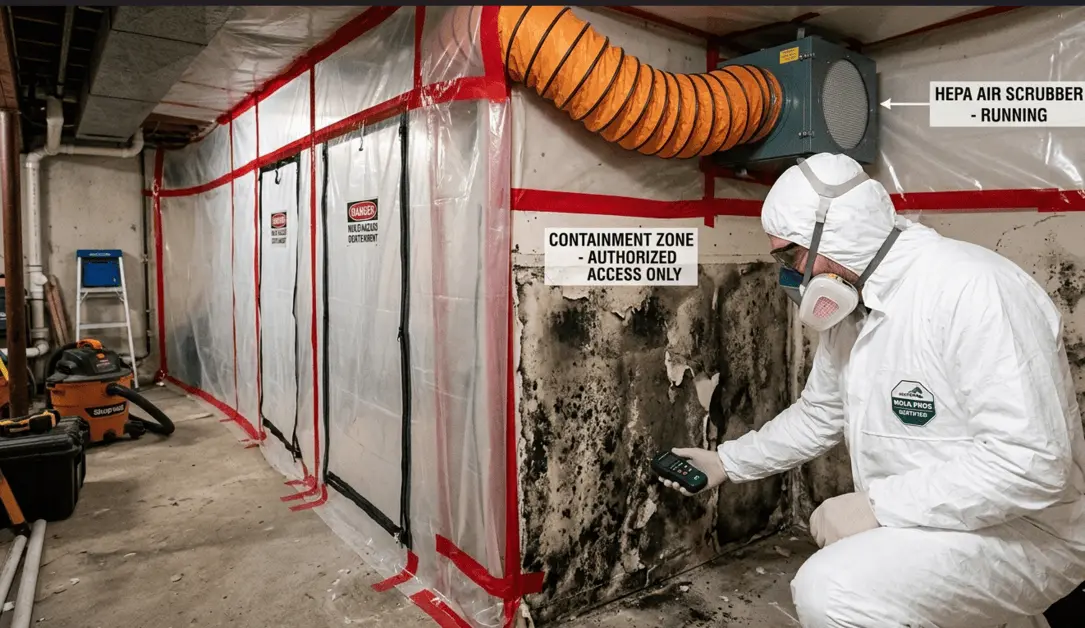
The mold remediation process involves 8 core steps: initial inspection and assessment, moisture source identification and repair, containment setup, air filtration, removal of contaminated materials, surface cleaning and treatment, drying and dehumidification, and post-remediation clearance testing. If you skip even one of these steps, the mold will come back, usually worse than before.
That’s the short answer. But if you want to understand why each step matters, what professionals actually do in each phase, and how to avoid getting ripped off or left with unresolved mold issues, keep reading.
What Is Mold Remediation, and Why Does It Differ From Mold Removal?
Most people use “mold removal” and “mold remediation” interchangeably. They mean different things.
Mold removal implies permanently eliminating all mold, which is biologically impossible. Mold spores exist naturally in all indoor and outdoor air, so the goal isn’t zero spores. It’s getting spore counts back to normal background levels while eliminating active growth and the conditions that caused it.
Remediation is the full process: containment, drying, cleaning, repairs, and verified clearance. The term mold remediation refers to the process used by restoration professionals to locate the cause of a mold problem and then take steps to eliminate it, including mold testing, cleaning of contaminated surfaces, and removal of materials damaged beyond repair.
One more critical truth: remediation without fixing the moisture source is a waste of money. This is the number one reason homeowners deal with recurring mold problems years after spending thousands on cleanup.
The 8-Step Mold Remediation Process (Done Correctly)
Step 1: Initial Inspection and Mold Assessment
Before anything is touched, a trained inspector needs to understand the full scope of the problem. This isn’t just walking around and pointing at visible black spots.
Locating every area that has been contaminated by mold is the first crucial step in the mold remediation process. Mold testing methods are used by environmental professionals to accurately assess the situation.
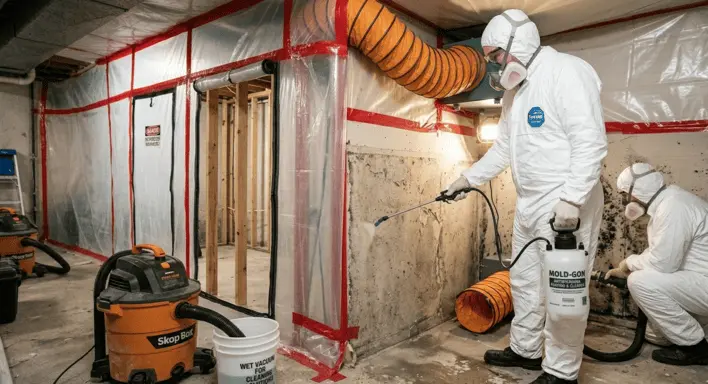
A thorough assessment includes:
- Visual inspection of all rooms, including wall cavities, attic spaces, crawl spaces, and behind baseboards
- Moisture meter readings to detect water intrusion points that aren’t visible
- Air sampling and surface testing to identify mold species and spore concentration levels
- HVAC system inspection is one of the most commonly missed contamination zones
Pre-remediation testing (air and surface samples sent to a lab) costs $300 to $600. Whether you need full lab testing or not depends on the situation.
The EPA says lab testing usually isn’t necessary when you can clearly see mold; put your budget toward fixing the moisture source and remediation. Use testing strategically when the answer will change the scope, timeline, or cost.
Related: How Long Does Mold Remediation Take? Real Timelines
Step 2: Fix the Moisture Source First, Not Last
This step is listed second because it should happen before any cleanup begins. Yet it’s routinely skipped, delayed, or done halfway. That is the single most expensive mistake in mold remediation.
Mold growth can begin within 24 to 48 hours of a moisture event on susceptible materials, so active water intrusion means you’re in a race. You can clean every surface in the house, if the leak is still dripping inside that wall, you’ll have mold again within days.
Common moisture sources that need to be corrected before remediation begins:
- Plumbing leaks behind walls or under slabs.
- Roof leaks are allowing water into the attic insulation.
- Poorly sealed windows and doors in humid climates.
- HVAC condensation dripping into ductwork.
- Foundation cracks are allowing groundwater seepage.
- Inadequate bathroom or kitchen ventilation.
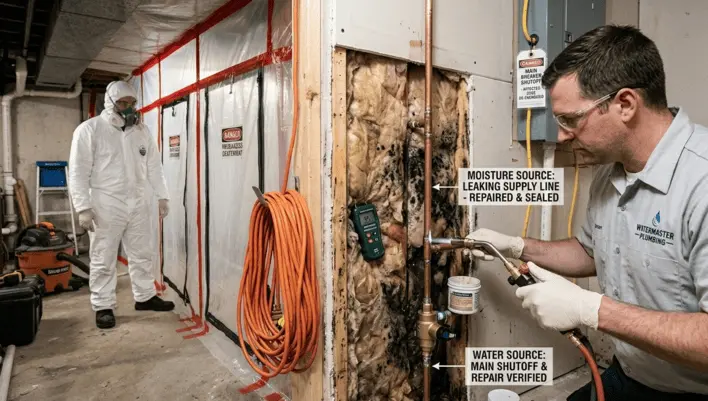
Once you’ve fixed the cause of the water leak, it will make it easier for a mold remediation expert to come in and start assessing the situation. Also, make sure to cut off power at the main breaker to the affected area; water and electricity don’t mix.
Related: Signs of Mold in Your Home in Charlotte, NC
Step 3: Containment, Stopping the Spread
Once the moisture source is controlled, the remediation team establishes containment. This is non-negotiable for anything beyond a tiny isolated patch.
The EPA and IICRC both use area-based size categories to classify remediation scope, which in turn determines required containment level, worker protection level, and whether independent third-party testing is required.
Here’s how the EPA broadly categorizes it:
- Under 10 sq ft: DIY-appropriate with N-95 mask, gloves, and goggles. No formal containment required.
- 10–100 sq ft: For anything over 10 square feet, the EPA suggests consulting or hiring a professional with mold remediation experience, and that containment be built immediately.
- Over 100 sq ft: Full containment with airlocks, negative air pressure machines, and daily clearance protocols.
Professional containment means sealing off the work zone with heavy polyethylene sheeting, taping every seam, and covering HVAC vents so spores can’t travel through the duct system into clean rooms. Workers establish a decontamination chamber (called a “decon anteroom”) where they remove contaminated PPE before re-entering the clean area.
Related: DIY vs Professional Mold Removal
Step 4: Air Filtration With HEPA Negative Air Machines
Inside the containment zone, industrial air scrubbers and negative air pressure machines run continuously. This is one of the areas where professional remediation truly separates itself from DIY.
These machines serve two simultaneous purposes:
- Create negative pressure, and air flows into the containment zone, not out of it. Any spores disturbed during removal get pulled toward the machine, not pushed into the rest of your home.
- HEPA filtration captures particles down to 0.3 microns. Mold spores range from 1–100 microns, so HEPA filtration catches them with high efficiency.
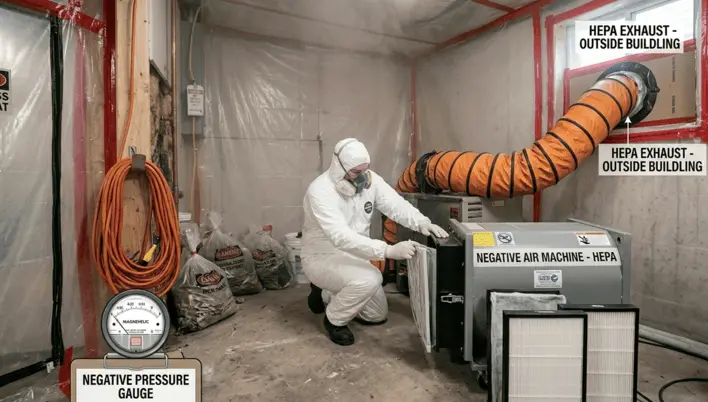
The machines’ exhaust filtered air outside the building through a window or duct setup. This process runs throughout demolition, cleaning, and drying phases, not just at the end.
Step 5: Removal of Contaminated Materials
This is the demolition phase. It’s more selective than it sounds; not everything gets ripped out, only materials that cannot be effectively cleaned.
The basic rule: porous = remove, non-porous = clean.
Materials that are typically removed:
- Drywall and gypsum board with visible mold penetration.
- Insulation (virtually impossible to clean, inexpensive to replace).
- Carpet and carpet padding.
- Ceiling tiles.
- Heavily contaminated wood framing (in severe cases).
Materials that can typically be cleaned:
- Concrete and masonry.
- Tile and glass.
- Metal framing and ducts.
- Solid wood (depending on penetration depth).
Spray moldy materials like drywall or carpeting lightly with a spray bottle of water before removing them in order to minimize the risk of mold spores being dispersed into the air.
Using a vacuum with a HEPA filter while cutting into moldy drywall will also help prevent spores from being dispersed during the process. Seal removed materials in heavy plastic trash bags before carrying them through the house for disposal.
Workers doing this must wear full PPE: an N-95 face mask, gloves, hair and shoe covers, and clothing that will either be disposed of or laundered in hot water immediately after. In some cases, a Tyvek suit is necessary.
Step 6: Surface Cleaning and Antimicrobial Treatment
Once porous materials are removed, the remaining structural surfaces are cleaned and treated. This phase has a sequence that matters:
a) HEPA Vacuuming Before any wet cleaning begins, HEPA vacuums remove loose spore debris from all surfaces, framing, subfloors, concrete, and the inside of the containment barriers themselves.
b) Physical Scrubbing: Scrub mold off hard surfaces with detergent and water, and dry completely. The physical removal of biomass is just as important as applying any chemical product. Fungicides don’t penetrate layers of dead mold growth effectively; the surface needs to be mechanically cleaned first.
c) Antimicrobial / Fungicide Application After cleaning, EPA-registered fungicides or antimicrobial solutions are applied to all treated surfaces. Apply a fungicide like Foster 40-80 or similar products that are registered specifically for mold remediation. This kills residual spores on the surface.
d) Encapsulation (Where Applicable) The mold remediation team then applies a special mold-resistant encapsulating coating to the affected space. This stops mold from coming back and prevents future growth. This step is typically used on wood framing and concrete surfaces that remain after cleanup, particularly in attics, crawl spaces, and basements.
Step 7: Drying and Dehumidification
After cleaning, the affected area needs to reach specific moisture content levels before it can be rebuilt or closed up. This step is where many amateur efforts fail; the area looks dry but isn’t.
Professional teams use:
- Industrial dehumidifiers to pull moisture out of the air and from within building materials
- Air movers to accelerate surface evaporation
- Moisture meters and thermal imaging cameras to confirm drywall, framing, and subfloor materials have returned to acceptable moisture levels (typically below 15–19% for wood)
Drying and verification add several days, as materials must reach specific moisture levels before final testing occurs. Trying to rush this phase leads directly to mold recurrence. Rebuilding over materials that still hold elevated moisture is the setup for a repeat problem in 6–18 months.
Step 8: Post-Remediation Testing and Clearance
This is the most skipped step in the entire process, and it’s the one that separates a finished job from a verified job.
The final step in the remediation process is to conduct a post-remediation inspection and thorough testing, a form of quality assurance. During it, your specialist will make sure your home looks good, there is no more mold, and will conduct testing on both air quality and moisture levels to ensure that the spores are gone and the environment that once hosted mold growth is no longer viable.
Post-remediation clearance testing adds $200 to $400. Critically, get this done by an independent tester, not the same company doing the remediation. This is not bureaucratic caution; it’s a genuine conflict of interest. A company clearing its own work has financial motivation to pass you rather than be honest.
What clearance testing covers:
- Air sampling for spore counts (compared against outdoor baseline samples).
- Surface swab or tape-lift samples from cleaned areas.
- Final moisture readings throughout the structure.
- Visual inspection of all containment removal.
Without this step, you could be moving back into a house that’s harmful to your health.
DIY vs. Professional Mold Remediation: Where the Line Is?
People ask this constantly. Here’s an honest, non-alarmist answer.
DIY is appropriate when:
- The affected area is under 10 square feet
- The mold is on a non-porous surface (tile, glass, sealed concrete)
- You can identify and fix the moisture source yourself
- No one in the household has respiratory conditions, weakened immunity, or mold allergies
Call professionals when:
- Larger areas, hidden contamination, HVAC involvement, or health-vulnerable individuals occupying the property require professional intervention.
- Mold has spread into wall cavities, under flooring, or into the attic
- Sewage-related mold, extensive HVAC contamination, or growth affecting structural materials require specialized mold removal steps that only trained professionals can safely perform.
- You’re preparing for a real estate transaction and need documentation
How Long Does Mold Remediation Take?
Timeline varies significantly by scope, but here’s a realistic breakdown:
- Small contained job (under 10 sq ft): 1 day
- Typical residential project: Containment and removal phases are often completed in 2–5 days. Drying and verification add several more days as materials must reach specific moisture levels.
- Large or multi-room contamination: 1–3 weeks
- HVAC or structural involvement: 2–4+ weeks, depending on extent
Don’t let any contractor pressure you into skipping the drying phase to hit a faster timeline. That shortcut causes more damage than it saves.
What Does Mold Remediation Cost?
Right now, the national average sits at $3,900, with typical projects ranging from $1,800 to $9,500, or $10–$32 per square foot.
Cost by location type:
- Attic: $1,000–$4,000 (higher if access is tight or a major roof leak spreads moisture). Bathroom: $500–$1,000 ($8,000+ if mold is behind vanities, showers, or walls). Basement: $500–$3,000 (rises with finished walls, paneling, or subfloor damage). Crawl space: $500–$2,000 (limited clearance and moisture control can push costs higher).
- HVAC remediation commonly runs $3,000–$10,000; ducts alone run $600–$2,000.
Important: A $1,500 cleanup becomes a $7,000 project once mold eats through drywall and into the studs. Delayed action is the most expensive variable in mold remediation.
Does Insurance Cover Mold Remediation?
This is where homeowners often get blindsided. The answer is: sometimes, but with significant conditions.
Insurance typically pays when mold results from a sudden, accidental water event, burst pipe, appliance failure, or storm roof leak. It’s denied for long-term humidity, ignored leaks, or flooding unless you carry separate flood insurance. Expect to cover your deductible ($500–$2,500) and costs above policy caps ($5,000–$10,000 is common).
Steps to protect your claim: Stop the moisture source and document damage with photos. Call your insurer and request an adjuster visit. Collect at least two written remediation estimates using identical scopes. Save every receipt to speed reimbursement.
How to Prevent Mold From Coming Back?
The remediation is complete. The clearance test passed. Now what? Prevention is an ongoing process, not a one-time event.
Key long-term strategies:
Control indoor humidity: Keep relative humidity between 30–50% year-round. In humid climates, this means running dehumidifiers consistently, not just in summer.
Fix water intrusion immediately: Mold growth can begin within 24 to 48 hours of a moisture event, so a “I’ll get to it this weekend” mentality with a plumbing leak is genuinely risky.
Improve ventilation: Bathrooms, kitchens, and laundry areas need exhaust fans that actually vent outside, not just into the attic space above.
Inspect regularly: Check under sinks, around water heaters, around window frames, and in crawl spaces twice a year. Catching a small wet spot before it becomes a mold colony is a thousand-dollar difference.
Don’t store porous materials in damp areas: Cardboard boxes, fabric furniture, and paper in a damp basement or garage are moldy food. Move them or replace them with plastic bins.
Hiring a Mold Remediation Contractor: Questions to Ask Before You Sign
Not every mold remediation company is operating at the same standard. Some are excellent. Some will clean what’s visible, hand you a bill, and leave your moisture problem untouched.
Ask these questions before you hire:
- Are you certified by IICRC (Institute of Inspection, Cleaning and Restoration Certification) or a state-licensed mold contractor?
- Will you fix or document the moisture source as part of the scope?
- What does your containment protocol look like? Do you use negative air machines?
- Do you perform post-remediation clearance testing, or will that be done by an independent party?
- What’s included in the contract: inspection, plastic containment, negative air with HEPA, removal and bagging of porous materials, cleaning and disinfection, drying, and proper disposal? Repairs and clearance testing should be listed separately.
- What warranties do you offer, and are they tied to passing a third-party clearance test?
Make sure the contractor has experience cleaning up mold, check references, and ask the contractor to follow the recommendations in the EPA guide Mold Remediation in Schools and Commercial Buildings, the guidelines of the ACGIH, IICRC, or other guidelines from professional or government organizations.
The Regulatory Framework Behind Professional Mold Remediation
Understanding who sets the rules helps you hold contractors accountable.
Regulatory scope is defined primarily by the U.S. Environmental Protection Agency (EPA), the Occupational Safety and Health Administration (OSHA), and, at the state level, licensing boards in states that mandate contractor certification. The IICRC Standard S520, Standard and Reference Guide for Professional Mold Remediation, is the dominant industry technical standard used by contractors and referenced by courts and insurers.
The EPA and NYC DOH documents have become the standard of care for mold assessment and remediation in buildings. The EPA document sets action levels for types of containment and worker protection based on the amount of surface area affected by mold.
No federal regulations set an acceptable airborne mold concentration. As of current EPA guidance, there are no EPA regulations or standards for airborne mold concentrations. This means clearance decisions rely on professional judgment guided by industry standards, not a single universal number.
Final Takeaway
Mold remediation done right isn’t complicated, but it requires discipline at every step. The failures happen when someone skips the moisture source repair, rushes the drying phase, or skips clearance testing because “it looks fine.” Those shortcuts turn a $2,000 job into a $9,000 one eighteen months later.
Follow the eight steps in sequence. Hire certified professionals for anything beyond a small isolated patch. Insist on independent post-remediation testing. And fix the moisture problem permanently, because no amount of cleaning, scrubbing, or antifungal coating will keep mold away if the underlying water problem is still there.
