How Long Does Mold Remediation Take? Real Timelines

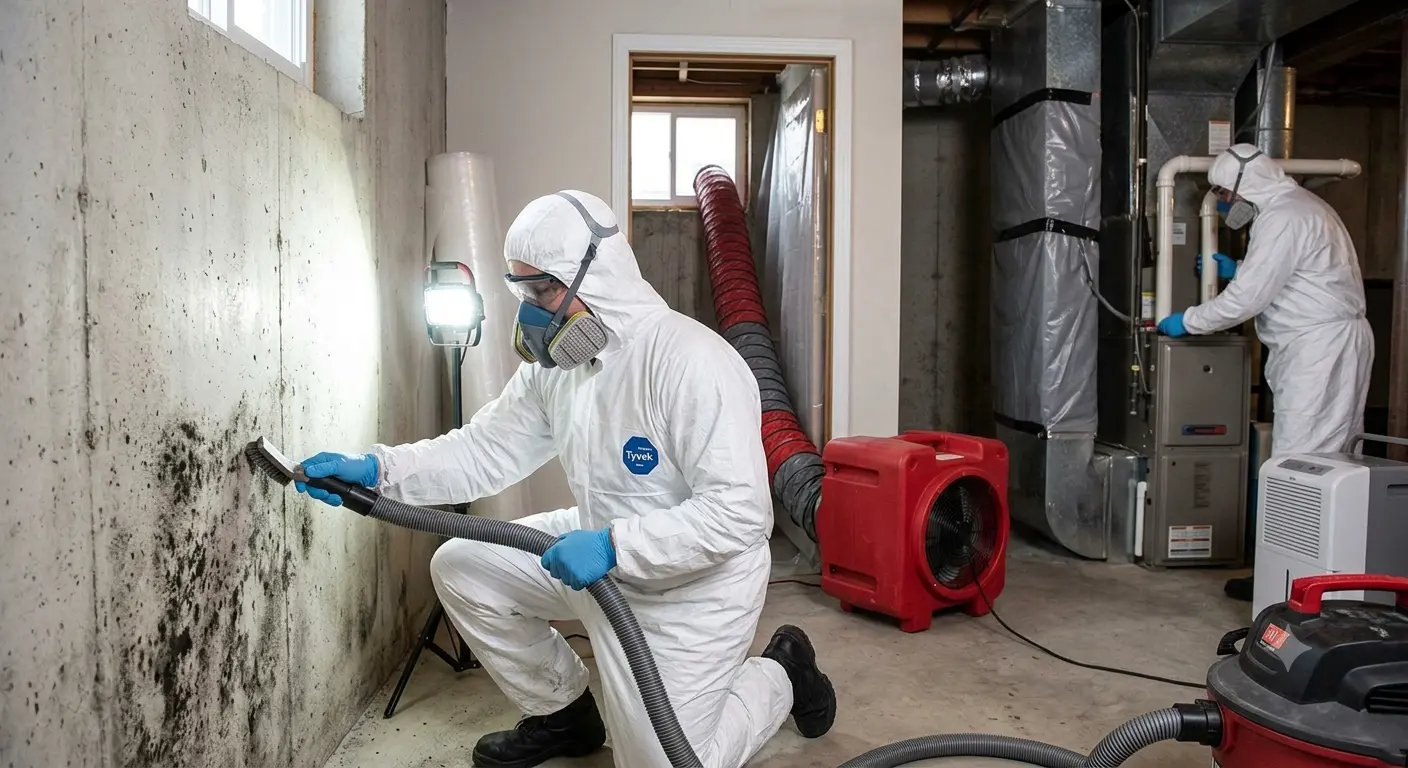
Mold remediation takes 1 to 5 days for most residential homes. Small, isolated patches under 10 square feet can be resolved in a single day. Moderate infestations across one or two rooms typically run 2 to 5 days. Large-scale or whole-house contamination ,especially involving HVAC systems, crawl spaces, or structural materials ,can take 1 to 3 weeks from start to clearance.
That’s the direct answer. But “it depends” is also genuinely true here ,and the factors it depends on are specific enough to be useful. Read on to find out exactly where your situation lands, why certain jobs take longer than you’d expect, and what legitimate contractors do during each phase of that timeline.
Why the Timeline Varies So Much, The 5 Core Factors?
Before jumping into specific scenarios, you need to understand what actually controls how long a remediation job takes. Every contractor who gives you a quote is estimating based on these variables. Knowing them lets you sanity-check what you’re being told.
1. Size of the Affected Area
This is the biggest driver. Small areas under 10 square feet may be remediated in 1–2 days, medium areas of 10–100 square feet typically require 2–5 days, and large areas over 100 square feet or whole-house infestations can take a week or longer. Commercial buildings with extensive mold issues may require several weeks for complete remediation.
2. Where the Mold Is Located
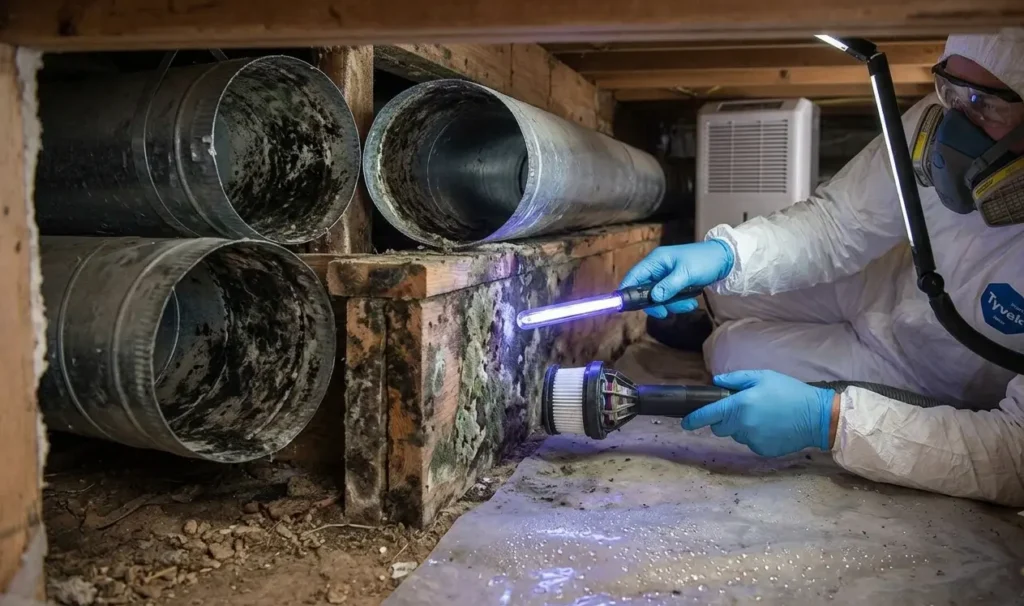
Location matters almost as much as size. Surface mold on visible walls can be addressed relatively quickly. Mold behind walls, under floors, or in crawl spaces extends the timeline significantly. Mold in HVAC systems requires specialized cleaning and may add days to the process. When mold is discovered in hidden areas during remediation, the timeline often extends as these newly discovered areas are addressed.
Related: Signs of Mold in Your Home
3. What Surfaces Are Affected
Mold tends to favor porous materials like drywall, upholstery, and wood because they provide the organic material molds need to flourish. These instances are more time-consuming and complicated to deal with, sometimes requiring removal and replacement of infected materials. Non-porous surfaces like tile or metals can be cleaned in a shorter timeframe.
4. The Moisture Problem Underneath
The mold you can see isn’t the whole problem ,it’s a symptom. How long remediation takes depends heavily on finding and fixing the moisture problem that caused the mold growth. Simple issues like a leaky faucet are quick fixes, but complex problems take more time. Hidden leaks in walls, foundation moisture issues, or HVAC system problems require investigation and repairs that can add days or weeks to the timeline.
5. Mold Type and Toxicity
Not all mold remediates the same way. Highly toxic species like Stachybotrys ,also known as black mold ,pose serious health risks and necessitate specific removal techniques. Identifying mold type and toxicity impacts the choice of remediation methods and the process duration. Black mold jobs run longer because workers must take additional containment and decontamination precautions that add hours to each day of work.
Timeline Breakdown: Phase by Phase
Understanding what happens during those 1–5 days makes the timeline far less mysterious. Here’s what each phase actually takes:
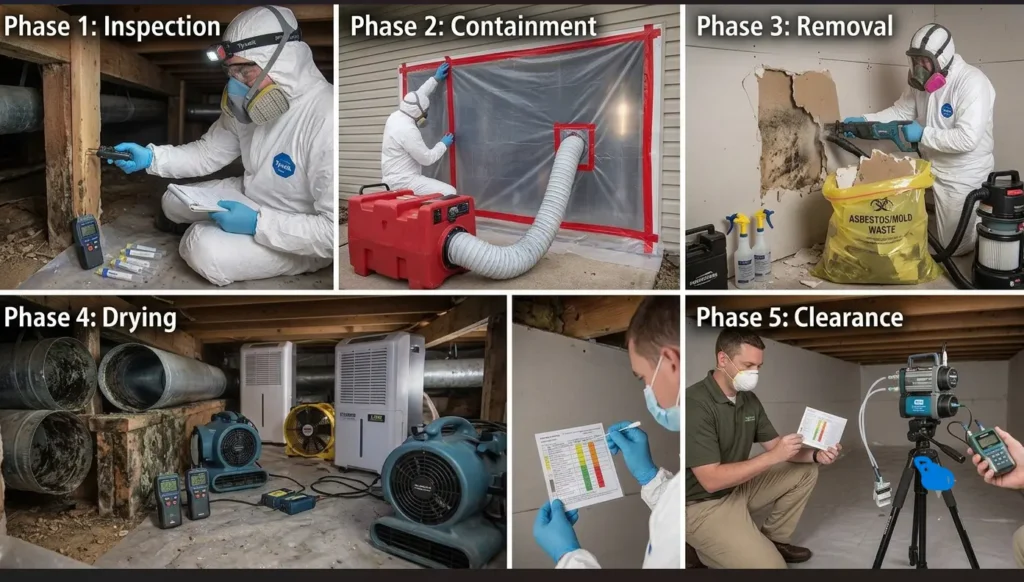
Phase 1: Inspection and Assessment ,Half a Day to 1 Day
Before any work begins, a professional needs to understand the full scope. This initial assessment typically takes about a day but may extend longer if the contamination is hidden or spread across multiple areas. It includes moisture meter readings, air and surface sampling where needed, HVAC inspection, and mapping of all affected zones.
Don’t let anyone skip this phase to “save time.” Starting remediation without a complete picture of where the mold is means you’ll inevitably miss sections ,guaranteeing a callback or a recurrence.
Phase 2: Containment Setup ,2 to 4 Hours
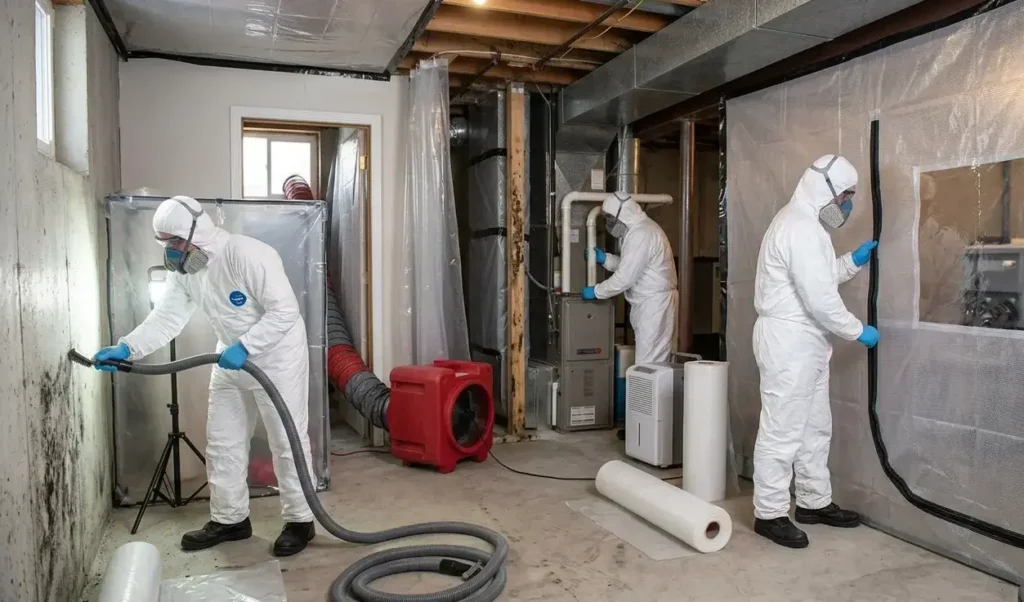
Professional containment means sealing off the work zone with polyethylene sheeting, taping every seam, covering HVAC vents in the affected area, and setting up a decontamination anteroom. A negative air machine or air scrubber is also installed to start removing excess moisture and pollutants from the room. It is also recommended that the homeowner turns off the HVAC system or closes ventilation to affected spaces ,recycled airflow can spread mold spores to other areas.
On large jobs with multiple contaminated rooms, containment setup alone can take most of a day as each zone needs its own sealed barriers.
Phase 3: Mold Removal, 1 to 5 Days
This is the core demolition and removal phase. Small jobs might finish in one day, while larger projects could take a full week or more. This phase includes removing contaminated materials, cleaning all surfaces with specialized solutions, and treating affected areas.
Porous materials ,drywall, insulation, carpet ,get bagged and removed. Non-porous surfaces get HEPA-vacuumed, scrubbed, and treated with EPA-registered fungicides.
Phase 4: Drying and Dehumidification, 2 to 5 Days
This is the phase that homeowners most often underestimate, and it’s where corners get cut when contractors are trying to look efficient. Drying is not optional filler ,it’s the phase that determines whether your remediation holds.
Drying and verification add several days, as materials must reach specific moisture levels before final testing occurs. Industrial dehumidifiers and air movers run continuously until moisture meters confirm wood framing, concrete, and subfloor materials have returned to safe moisture content ,typically below 15–19% for wood.
If a contractor tells you drying only takes a day, ask them what moisture content readings they’re targeting and how they’re measuring it. If they can’t answer specifically, that’s a red flag.
Phase 5: Post-Remediation Clearance Testing ,1 to 2 Days
The final inspection and clearance typically take 1–2 days, involving a thorough assessment of moisture levels and checking for any remaining mold residues. This ensures the mold remediation process has been successful and no mold remains.
Clearance testing should always be performed by an independent third party ,not the company that did the remediation. Air samples are compared against outdoor baseline levels, and surface samples confirm cleaned areas pass. Until clearance is confirmed, the job is not done.
How Long Does Mold Remediation Take by Location?
Different parts of a home have wildly different timelines because of access, materials, and contamination patterns. Here’s what to expect by specific location:
Bathroom ,1 to 3 Days
A small mold patch around a shower or tub can often be resolved in a day. However, bathroom mold is deceptive ,a small patch on bathroom drywall might be resolved in a day, while mold hiding behind vanities, behind shower surrounds, or inside wall cavities can extend the timeline to several days. Surface tile mold is fast. Mold that’s been growing behind the tile backer for months is a different job entirely.
Basement, 2 to 5 Days
Basements are high-humidity environments with lots of porous surfaces. A relatively contained basement job runs 2–3 days. If the mold has spread across finished walls, under flooring, or into subfloor framing, expect 4–7 days including drying time.
Attic, 1 to 7 Days
Attic remediation varies enormously based on roof leak history and access. Expect 1 day for small areas up to 7 days for large areas inside an attic. Attics with extensive roof leak damage that has spread through insulation and into decking boards sit at the longer end of that range.
Crawl Space, 1 to 10 Days
Crawl spaces are among the most labor-intensive remediation environments. Expect 1 day to 10 days depending on the size of the area in need of treatment and whether it’s a tight crawl space or one with plenty of working room. Tight clearance means workers can’t use equipment efficiently, every step takes longer, and drying takes more time because airflow is limited.
Inside Walls or Ceilings, 1 to 4 Days
For mold removal inside walls or ceilings, expect 1 to 4 days depending on how much material needs to be removed and accessibility. This time includes demo, cleaning structural framing, and the rebuilding estimate (which is typically quoted separately).
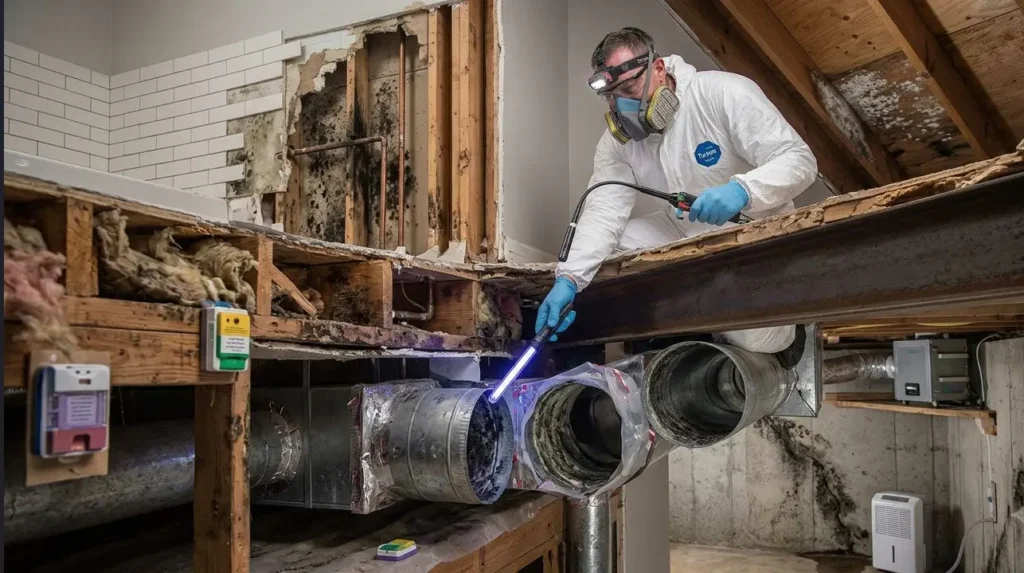
HVAC and Duct System, 2 to 4 Days
For mold removal from HVAC and ducting systems, expect 2 to 4 days. HVAC contamination is treated as its own zone ,ductwork needs to be sealed, each air handler becomes its own containment area, and every register needs to be cleaned or replaced. This is the scenario where mold can most rapidly spread to otherwise-clean areas of a home if the system keeps running during remediation.
Whole House, 4 to 14 Days
For mold removal from an entire house, expect 4 to 9 days depending on the size of the home and how much contents are inside. Factor in clearance testing time and potential drying extensions, and realistic whole-house timelines run 1–2 weeks for most residential properties.
Special Scenarios That Extend the Timeline
Sewage-Related Mold
If sewer wastewater was the cause of the mold, expect to add another 2 to 7 days to any mold removal project. Sewage contamination triggers a higher biohazard protocol ,additional PPE, different disposal procedures, more extensive surface treatment, and often stricter clearance standards before occupancy is allowed.
Water Damage Running Concurrently
When active water damage coincides with mold, the remediation can’t fully begin until the water mitigation phase is complete. If active water damage is present, it must be resolved before mold remediation can be completed. Drying out water-damaged areas adds time to the overall process. In cases where significant water damage has occurred, such as after flooding, the preliminary water mitigation can add several days to the timeline before mold work begins.
Hidden Mold Discovered Mid-Job
One of the most common timeline surprises: a contractor opens a wall expecting a small pocket of mold and finds it has spread three feet in either direction through the cavity. When mold is discovered in hidden areas during remediation, the timeline often extends as these newly discovered areas are addressed.
A good contractor will document this discovery, adjust the scope in writing, and walk you through what was found before proceeding. This is normal and honest ,it means the original inspection simply couldn’t see through the wall.
Can You Stay in Your Home During Mold Remediation?
This question matters practically and financially ,alternative accommodations add real cost.
For most jobs, yes, you can stay home. Professionals isolate work zones with sealed containment barriers, and the rest of the house remains accessible. For longer projects, for projects lasting 3–5 days, staying elsewhere may be recommended.
However, some situations require temporary relocation: extensive containment, toxic mold, or HVAC disconnection typically requires temporary evacuation. Vulnerable populations like children, the elderly, and immunocompromised individuals should relocate during remediation for health and safety protection.
Ask your contractor directly: “Given the scope of this job, do you recommend I stay or leave?” A good contractor will give you an honest answer based on what they found ,not based on what’s easiest for them.
What Homeowners Can Do to Speed Up the Timeline?
You’re not just a passive bystander in this process. A few preparation steps genuinely shorten the job:
- Clear the work area before the crew arrives. Remove personal belongings from contaminated spaces to prevent cross-contamination and clear pathways and work areas of obstacles to improve professional access.
- Turn off the HVAC. Closing ventilation to affected spaces prevents mold spores from circulating throughout your home and keeps containment cleaner.
- Document everything now. Document all affected areas with photographs and notes for your insurance claim before anything gets removed or disturbed.
- Fix small water sources immediately. If there’s a dripping pipe under the sink or a slow roof leak you’ve been ignoring, address it before the crew arrives. Every hour of active moisture intrusion during drying extends that phase.
- Don’t rush the drying phase. If a contractor says they can skip or shorten drying to fit your schedule, say no. Rebuilding over wet materials is the number one cause of mold recurrence within 12–18 months.
Red Flags That Signal a Job Is Being Rushed
Not every mold remediation company follows the same standards. Knowing what a rushed or incomplete job looks like protects you.
Red flag #1: No containment barriers. If workers are working in an open area without plastic sheeting and sealed vents, spores are spreading through your home during every hour of that job.
Red flag #2: No post-remediation clearance test. If a contractor declares the job complete without independent air and surface sampling, you have no verified proof the mold is actually gone.
Red flag #3: Skipping moisture source repair. A crew that cleans surfaces without addressing the underlying water problem is doing half a job. The mold will be back.
Red flag #4: Dramatically faster timeline than competitors. The mold industry is like the Wild Wild West. A quote promising a 3-room basement job in one day when everyone else is quoting 4 days isn’t necessarily efficient ,it might mean skipping containment, cutting drying short, or not doing clearance testing. Get at least two detailed quotes and compare what’s actually included.
The Rebuild Phase: What Comes After Remediation
Remediation and reconstruction are two different scopes, typically quoted separately. After mold cleanup and clearance, damaged materials need to be replaced:
- Drywall replacement
- Insulation reinstallation
- Flooring repair or replacement
- Painting and finishing
In severe cases, rebuilding or restoring areas with significant mold damage can add to the project timeline. Replacing drywall, flooring, or cabinets may be necessary if mold exposure was prolonged.
Reconstruction typically adds 2–5 days for a standard room, longer for whole-floor or structural rebuilds. Some restoration companies handle both remediation and reconstruction under one contract. Others subcontract the rebuild to a separate general contractor. Either approach works ,just make sure the timeline and scope for each phase are documented separately so you know exactly what you’re paying for.
Quick Reference: Mold Remediation Timeline by Scenario
| Scenario | Typical Timeline |
| Small patch, bathroom tile (under 10 sq ft) | 1 day |
| Single room, drywall affected | 2–3 days |
| Basement, moderate contamination | 2–5 days |
| Attic, moderate contamination | 3–5 days |
| Crawl space | 1–10 days |
| HVAC/ductwork | 2–4 days |
| Multiple rooms | 5–10 days |
| Whole house | 7–14 days |
| Sewage-involved mold | Add 2–7 days to any above |
| Commercial property | 1–3 weeks+ |
The Bottom Line
The honest answer to “how long does mold remediation take” is: as long as it takes to actually fix the problem ,and not one day less.
In most cases, mold remediation takes between 1 and 5 days for residential properties. But the drying phase alone can tack on several more days, and clearance testing adds another day or two at the end. Trying to compress those phases is how a $3,000 remediation job becomes an $8,000 recurrence problem eighteen months later.
The best thing you can do is hire a certified contractor, insist on independent post-remediation testing, fix the underlying moisture source, and let the drying phase run its proper course. Everything after that is just patience.
